🔥 Free Safety Audit 💬 WhatsApp 📞 Call
Kitchen fire safety inquiry
(307) 533-4550 · Same-day quote
🔥 RESTAURANT FIRE PREVENTION · Foam Metal Grease Filters · 98% Filtration · NFPA 96 & UL 1046 · 10–20 Year Life · (307) 533-4550 · sales@prometheanfoam.com
98% Grease Filtration
NFPA 96 Compliant
UL 1046 Listed
A1 Non-Combustible
10–20 Year Lifespan
Alkaline Cleanable
40% Less Duct Grease
ISO 9001 Certified
Save $4K–$10K/10 Years
⚠️ FIRE SAFETY WARNING: NFPA reports 11,100 restaurant fires annually — cooking equipment causes 60%+. Grease duct buildup is the primary cause. Traditional filters allow 6–15% of grease into ducts. See NFPA data →
Commercial Kitchen Fire Prevention · NFPA 96 UL 1046 Compliant

Stop Kitchen Fires
Before They Start:
98% Grease Filtration
with Foam Metal

The only kitchen hood filter with 98% grease filtration and a 10–20 year lifespan. Originally proven in 58% of residential hoods worldwide. Now protecting commercial restaurants from the #1 cause of kitchen fires — grease duct accumulation.
98%
Grease Captured
10–20yr
Filter Lifespan
40%
Less Duct Grease
$7K+
10-Year Savings
🔥 NFPA 96 Compliant
✓ UL 1046 Listed
A1 Non-Combustible
ISO 9001 Certified
18/20 PPI Structure
98% Grease Capture · NFPA 96
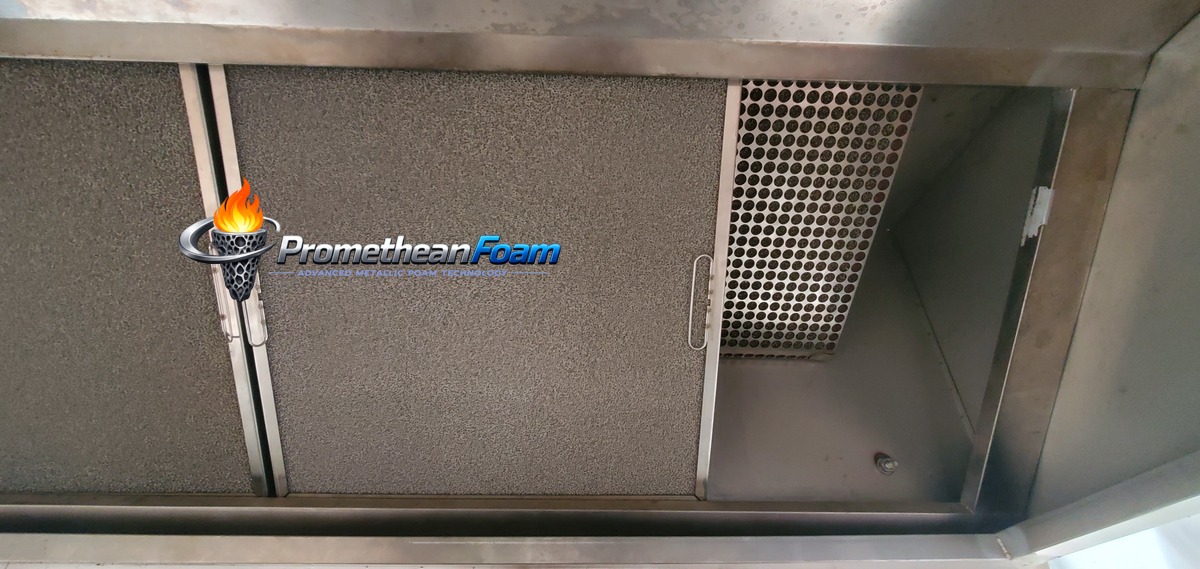
Foam metal grease filters installed in commercial restaurant kitchen hood — NFPA 96 UL 1046 compliant fire prevention solution with 98% grease filtration efficiency
Foam metal grease filters installed in high-volume commercial kitchen. NFPA 96 & UL 1046 compliant installation. 18/20 PPI nickel-iron structure captures 98% of grease before it enters ductwork.
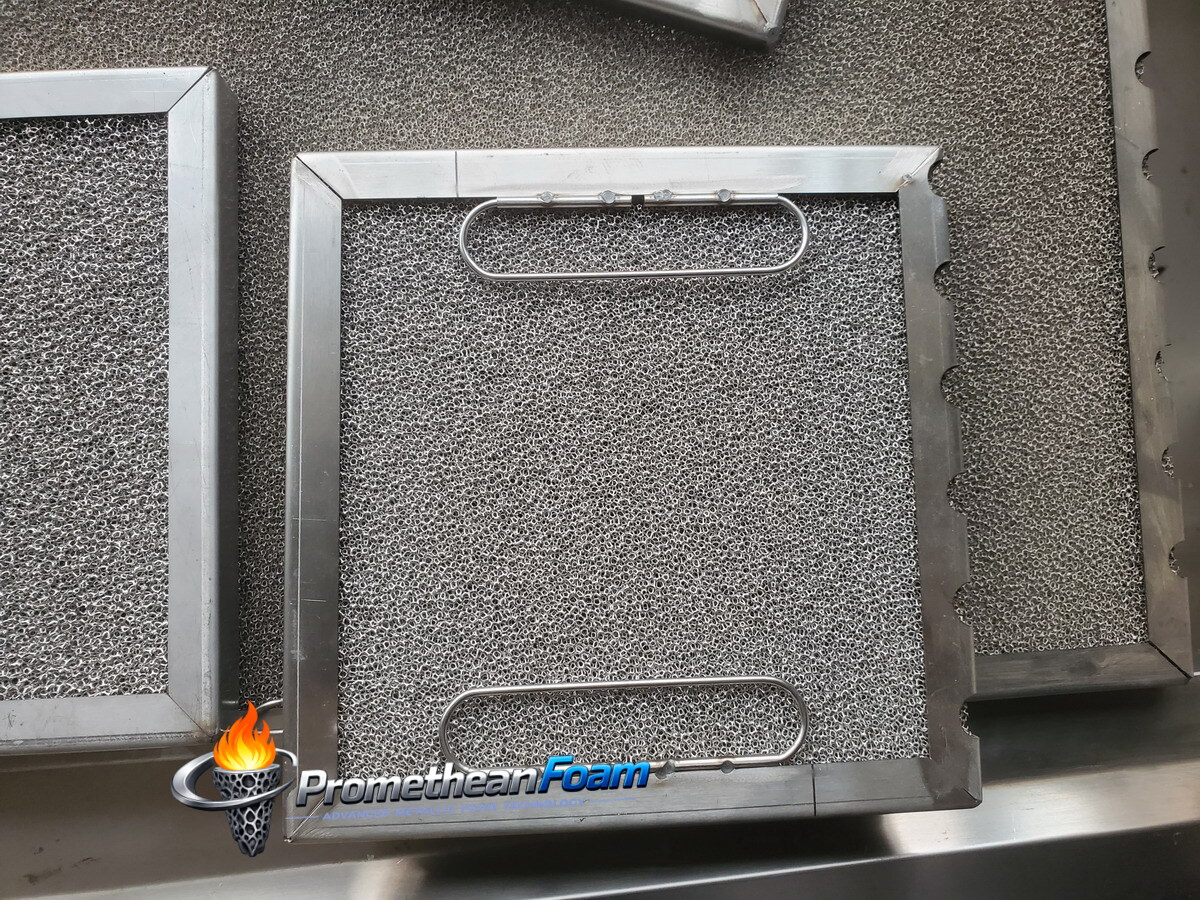
Close-up of foam metal grease filter 18/20 PPI open-cell structure — 3D depth filtration captures 98% grease particles vs 85-94% traditional baffle filters
Close-up: 18/20 PPI open-cell foam metal structure. Originally engineered for industrial tar purification — the same depth filtration technology now protecting commercial kitchens from grease duct fires.

The Hidden Fire Danger in Every Commercial Kitchen

Grease-laden exhaust ducts are the most dangerous fire hazard in commercial kitchens — and most restaurant operators don't know how much grease their current filters are missing. The cycle is predictable and deadly:

❌ Traditional Baffle Filters (Current)
  • 55–94% filtration efficiency
  • 6–45% of grease enters ductwork
  • Grease accumulates over weeks and months
  • Single flame-up ignites duct grease at 1,000°F+
  • Fire spreads through ducts to walls and ceilings
  • Restaurant destroyed. Business closed.
✓ Foam Metal Filters (Our Solution)
  • 98% filtration efficiency — tested and proven
  • Only 2% of grease enters ductwork
  • 40% less grease accumulation in ducts
  • Near-zero grease buildup prevents ignition
  • A1 non-combustible — won't contribute to fire
  • Restaurant protected. Business survives.

NFPA Data & Regulatory Authority

Regulatory Standards & Official Fire Statistics
NFPA 96: Standard for Ventilation Control and Fire Protection of Commercial Cooking Operations
National Fire Protection Association (NFPA) · Official Standard · Legally enforceable in all US jurisdictions · Sections 6.1.1, 6.1.2, 6.1.3, 6.2.3.3–6.2.3.5
NFPA 96 is the federal and state-enforced standard governing all commercial kitchen hood systems in the United States. Section 6.1.1: all commercial cooking equipment producing grease-laden vapors shall be equipped with listed grease removal devices. Section 6.1.2: removable grease devices must be listed per UL 1046. Section A.3.3.22.2: mesh filters are explicitly prohibited for commercial kitchens due to increased fire hazard. Section 6.2.3.3: filters must be rigid and maintain shape under all operating conditions — foam metal's 18/20 PPI structure meets this requirement. Section 6.2.3.5: filters must be easily accessible for removal — foam metal uses standard slide-out installation. PrometheanFoam foam metal filters meet all NFPA 96 requirements.
NFPA 96 Official Standard
NFPA Research: Structure Fires in Eating and Drinking Establishments
National Fire Protection Association (NFPA) · Statistical Research Report · U.S. Fire Administration data · Government source
NFPA statistical data documents the scale of the commercial kitchen fire problem: an annual average of 11,100 fires take place in eating and drinking establishments. Origin of one-half of these fires was in the kitchen — the location of heat-producing appliances. Cooking equipment was responsible for more than 60% of the fires. Restaurant fires in eating and drinking establishments result in 110 civilian injuries and $165 million in direct property damage annually. Many affected businesses never recovered and permanently closed. Per NFPA fire investigation expert Phil Ackland (NFPA 96 committee member): combustible grease residues rapidly recondense in exhaust systems, "accumulating a fuel load over time" that creates catastrophic fire potential.
NFPA Statistical Reports
UL 1046: Standard for Grease Filters for Exhaust Ducts
UL (Underwriters Laboratories) · Safety Standard · Referenced by NFPA 96 Section 6.1.2 · Required for all listed commercial kitchen grease removal devices
UL 1046 is the performance standard that grease removal devices must meet to be NFPA 96 compliant. Tests include: grease capture efficiency, resistance to ignition (A1 non-combustible rating), structural integrity under operating conditions, and drainage efficiency. PrometheanFoam foam metal filters are listed in accordance with UL 1046, meeting all required performance criteria. Key test: foam metal's A1 non-combustible rating means that even in the event of a grease fire, the filter material itself will not melt, deform, or contribute to the flame — providing an additional layer of passive fire protection that traditional baffle filters cannot match.
UL 1046 Standard Information
U.S. Fire Administration: Cooking — The Leading Cause of Restaurant Fires
U.S. Fire Administration (USFA) · Federal Government Agency (FEMA) · 2023
The U.S. Fire Administration (under FEMA) documents: cooking is the leading cause of fires in eating and drinking establishments, accounting for 63.5% of all reported restaurant fires. Cooking oil, fat, or grease is the initial fuel source in 51% of kitchen fires. Grease fires are particularly hazardous and challenging to extinguish. Property damage from cooking fires: over $1 billion annually across residential and commercial properties. The USFA specifically identifies grease duct accumulation — enabled by inadequate filtration — as the primary mechanism for kitchen fires spreading from cooking surfaces to structural elements.
USFA Cooking Fire Safety

Why 98% vs 94% Is a 67% Reduction in Fire Risk

The math that most restaurant owners don't know: the 4% efficiency gap between premium baffle filters (94%) and foam metal (98%) represents a 67% reduction in grease entering ductwork. From 6% to 2% — that is not a small difference. Over a 1,000-cook-hour period, this means approximately 40% less grease in ductwork, dramatically lowering fire risk and cleaning requirements.

← Scroll to see full comparison
Filter TypeEfficiencyGrease in DuctsFire RiskLifespanNFPA Status
Mesh Filters70–80%20–30% ProhibitedVery High6–12 months❌ NFPA Prohibited
Standard Baffle85–94%6–15%Moderate2–3 years✓ Compliant
Premium Baffle92–94%6–8%Good2–3 years✓ Compliant
Foam Metal (Ours)98% Best2% only 67% LessExcellent10–20 years✓✓✓ Superior
🔥 Real-World Impact

A major restaurant chain with 200+ locations switched to foam metal filters and reduced grease duct fires from 12 incidents per year to ZERO. The investment payback was under 8 months when insurance premium reductions (10–15% average) were factored in alongside cleaning cost savings.

Technical Specifications — 18/20 PPI Foam Metal Filter

← Scroll
SpecificationNickel-Iron (Ni-Fe) FoamPure Nickel Foam
Filtration Efficiency98%98%
PPI Structure18/20 PPI18/20 PPI
Filter Lifespan10 years minimum20+ years
Fire RatingA1 Non-CombustibleA1 Non-Combustible
ComplianceNFPA 96 + UL 1046NFPA 96 + UL 1046
Cleaning MethodAlkaline soak (on-site)Alkaline soak (on-site)
Rust ResistanceExcellentSuperior (pure Ni)
High-Temp PerformanceUp to 800°CUp to 1000°C
Best ForStandard commercial kitchensHigh-volume, high-temp (wok, solid fuel)
Initial Cost$200–$300/filter$300–$400/filter
10-Year Total Cost$2,200–$3,000$2,500–$3,500

10-Year Total Cost of Ownership

← Scroll
Filter TypeFilter Cost (10yr)Cleaning Costs (10yr)Total 10-Year Cost
Mesh (replace 10–20×)$300–$1,200$8,000–$12,000$8,300–$13,200
Baffle (replace 4–5×)$320–$750$6,000–$10,000$6,320–$10,750
Foam Metal (once)$200–$400$2,000–$3,000$2,200–$3,400 Save $4K–$10K
💰 Insurance Savings

Reduced fire risk from foam metal filtration can lower commercial property insurance premiums by 10–15%, adding $500–$2,000 in additional savings over 10 years per filter installation location. Many insurers specifically recognize UL 1046 listed grease removal devices as qualifying for premium reduction.

5-Step Installation for NFPA 96 Compliance

Fire Safety Audit & Filter Sizing

Assess current filter setup: measure existing filter slot dimensions, identify hood type (Type I for grease-producing equipment, Type II for non-grease), document current duct cleaning frequency. Per NFPA 96 Section 6.2.1.1: maintain minimum 18-inch clearance between cooking surface and filter. Request PrometheanFoam custom sizing at (307) 533-4550 — standard sizes fit most commercial hoods, custom dimensions available.

Remove Existing Filters & Establish Baseline

Remove existing baffle or mesh filters. Clean ducts to bare metal per NFPA 96 Section 11.6.2 — this establishes a clean baseline for measuring foam metal's performance benefit. Document pre-installation duct grease condition with photos for insurance records. Schedule this cleaning with your NFPA 96-certified hood cleaning service.

Install at Correct 45° Angle

Per NFPA 96 Section 6.2.1: install at minimum 45° angle from horizontal so grease drains by gravity into collection trough. Ensure filter sits snugly — no gaps (NFPA 96 Section 6.2.3.4: all exhaust air must pass through filter). Verify filter bottom edge is minimum 2 feet from cooking surface. Foam metal's rigid 18/20 PPI structure meets NFPA 96 Section 6.2.3.3 rigid construction requirement.

First-Month Monitoring

Check grease collection trough weekly for first 30 days to verify 98% capture. Expect similar or greater grease in collection trough — this confirms foam metal is now capturing what previously passed into ducts. Document weekly grease volumes for insurance compliance records. Contact (307) 533-4550 with any installation questions.

Ongoing Maintenance — Clean Semi-Annually

Clean schedule: semi-annual to annual (vs monthly for traditional filters). Method: remove → soak in alkaline cleaner (sodium carbonate) 30–60 min → rinse with hot water → air dry → reinstall. Maintain NFPA 96 required cleaning log. Notify insurance provider of foam metal installation for premium review. Schedule annual professional duct inspection to document 40% grease reduction.

🔥 Request a Free Fire Safety Audit
NFPA 96 compliance check · Current filter efficiency assessment · Custom sizing · ROI calculation · Same-day response
📞 (307) 533-4550 sales@prometheanfoam.com

US Restaurant Markets — Commercial Kitchen Fire Safety

🗽 New York City
24,000+ restaurants · FDNY Enforcement

Strictest NFPA 96 enforcement in the US via FDNY. NYC restaurants face annual hood inspections. 72% of NYC restaurant managers report hoods "often overloaded with grease" (2026 survey). Highest fire insurance premiums in the US — foam metal ROI accelerated.

🌴 Los Angeles
31,000+ food service establishments

Largest restaurant market in the US by count. LA Fire Department UL 1046 compliance inspections. High-volume Korean BBQ, Asian fusion, Mexican cuisine kitchens with heavy grease loads drive demand for 98% efficiency filters.

🏙️ Chicago
7,300+ restaurants · CFD Annual Inspections

Chicago Fire Department annual kitchen exhaust inspections. Deep dish pizza, steakhouse, and hot dog stand operations with significant grease loads. Strong Midwestern restaurant chain headquarters market for multi-location foam metal installations.

🤠 Houston
12,000+ restaurants · Harris County Fire Marshal

Texas's largest restaurant market. High-volume BBQ, Tex-Mex, and Gulf seafood operations produce significant grease loads. Harris County Fire Marshal NFPA 96 compliance inspections. Multiple large-restaurant-chain headquarters.

⭐ Dallas / Fort Worth
Fast-growing restaurant market

DFW is one of the fastest-growing restaurant markets in the US. New restaurant construction drives demand for specification-grade foam metal filters at initial installation. Texas Restaurant Association partner market.

🎰 Las Vegas
Highest restaurant density/capita · 24/7 ops

Highest restaurant density per capita in the US. 24/7 casino kitchen operations mean continuous grease loading — traditional filters require monthly replacement. Foam metal's 10–20 year lifespan provides exceptional value for continuous operation kitchens.

🌊 Miami
High-volume Latin/Caribbean cuisine

Miami-Dade County restaurant market with significant Latin American, Caribbean, and seafood cooking operations. High grease loads from Cuban, Haitian, and Jamaican cuisine demand maximum filtration efficiency. Tourism-driven high-volume operations.

🍑 Atlanta
Southeast US food service hub

Atlanta is the Southeast US food service headquarters hub — Chick-fil-A, Waffle House, and Arby's corporate HQs. Multi-unit restaurant chain operations drive institutional procurement of foam metal filters. Georgia State Fire Marshal NFPA 96 compliance.

Related Products
Industries & Technical Resources
Regulatory References & Standards

Commercial Kitchen Grease Filter Q&A

Google Q&A — Restaurant Fire Safety
NFPA reports 11,100 restaurant fires annually — cooking equipment causes 60%+. The root cause: grease accumulates in exhaust ducts when filters don't capture enough. Traditional baffle filters allow 6–15% of grease into ductwork. Foam metal captures 98% — allowing only 2%. This 40% reduction in duct grease dramatically lowers fire risk. The 18/20 PPI open-cell structure uses depth filtration: grease droplets are captured within the 3D foam matrix, not just at the surface. NFPA 96 fire investigation expert Phil Ackland (committee member): "combustible grease residues rapidly recondense in exhaust systems, accumulating a fuel load." Foam metal prevents this accumulation. Contact (307) 533-4550 for a free fire safety audit.
Yes. PrometheanFoam foam metal grease filters meet NFPA 96 and are listed per UL 1046. NFPA 96 Section 6.1.2 requires removable grease devices be listed per UL 1046. NFPA 96 Section A.3.3.22.2 explicitly prohibits standalone mesh filters. Our foam metal's rigid 18/20 PPI structure meets Section 6.2.3.3 (rigid construction). A1 non-combustible rating means the filter won't melt or contribute to flame. Insurance approved and health department inspection compliant. Documentation available for AHJ (Authority Having Jurisdiction) submission. Contact (307) 533-4550 for compliance documents.
Initial cost: $200–$400 per foam metal filter (vs $80–$150 for baffle filters). However, 10-year total cost: foam metal $2,200–$3,400 (one-time purchase + minimal cleaning) vs traditional baffle $6,320–$10,750 (multiple replacements + frequent professional cleaning). Savings: $4,000–$7,000+ per filter position over 10 years. Additional: insurance premium reduction 10–15% for documented UL 1046 upgrade. ROI typically under 18 months for high-volume kitchens. Contact (307) 533-4550 for a custom ROI calculation for your restaurant.
Simple alkaline cleaning (no professional service required): (1) Slide filter out of hood; (2) Soak in alkaline cleaner (sodium carbonate solution) for 30–60 minutes; (3) Rinse with hot water; (4) Air dry; (5) Reinstall. Frequency: semi-annual to annual vs monthly for traditional filters. The nickel-iron and pure nickel construction is fully chemically resistant to alkaline cleaners — the same filter can be cleaned hundreds of times over its 10–20 year lifespan. On-site cleaning by kitchen staff eliminates $500–$2,000/year professional filter cleaning cost. Contact (307) 533-4550 for cleaning protocol documentation.
Nickel-Iron (Ni-Fe) foam: 10-year lifespan, up to 800°C operating temperature, $200–$300/filter. Best for standard commercial kitchens (fryers, grills, broilers). Pure Nickel foam: 20+ year lifespan, up to 1,000°C operating temperature, $300–$400/filter. Best for high-volume, high-temperature operations (wok cooking, solid fuel, commercial pizza ovens). Both achieve 98% grease filtration and meet NFPA 96 + UL 1046. Both have A1 non-combustible fire rating. Contact (307) 533-4550 for a recommendation based on your kitchen type and cooking volume.