⚙️ ISO 9001 · AI-Matched · OEM/ODM · Global Shipping
Industrial Foam Metal Custom Solutions for Every Application
Open-cell porous metal — nickel, copper, aluminum, stainless steel, titanium — engineered for filtration, heat exchange, catalyst support, sound absorption, structural panels, energy storage, and more. Tell us your application; our AI matches the optimal foam configuration.
Coverage: Filtration · Heat Exchange (up to 15× enhancement) · Catalyst Supports (superior to monolith and packed bed) · Sound Absorption (60% attenuation) · Aerospace Structural Panels · EV Battery Electrodes · HVAC · Industrial Manufacturing. Porosity 40–95% · PPI 5–45 · Temperature up to 900°C · Surface area 500–5,000 m²/m³.
Industrial foam metal cross-section: open-cell porous structure, 500–5,000 m²/m³ surface area, 40–95% porosity. Available in Ni, Cu, Al, 316L SS, Ti.
Heat Exchange Application
Heat Exchange · 15× HTC · Al/Cu Foam
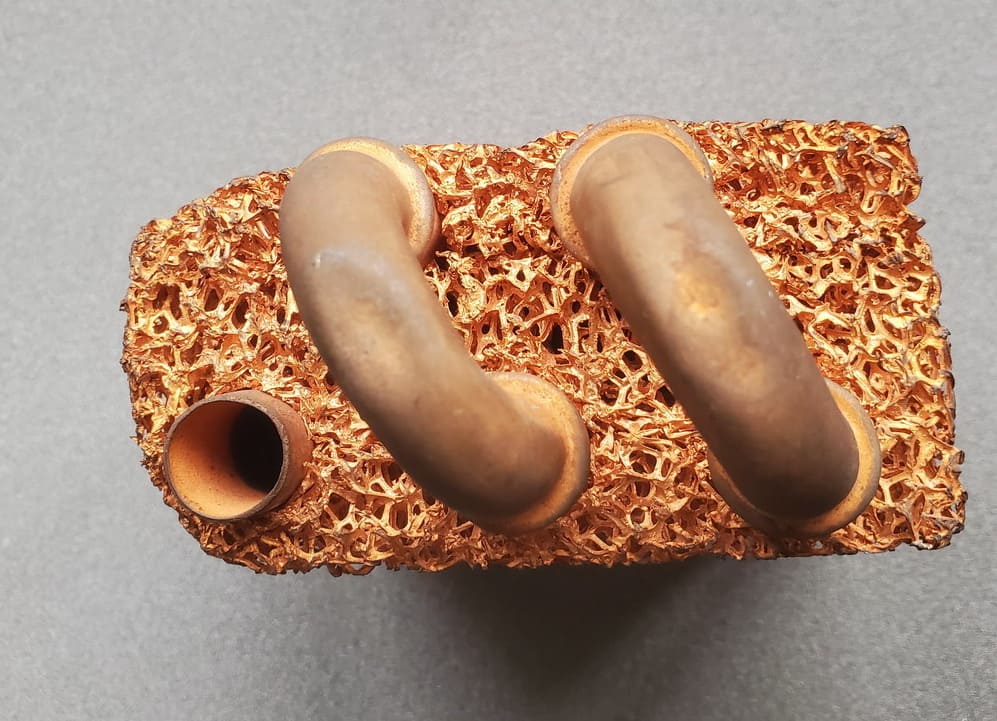
Aluminum/copper foam heat exchanger — up to 15× heat transfer coefficient enhancement (MDPI Fluids 2020). Natural and forced convection.
📸 Upload photos to: /wp-content/uploads/industrial-foam-metal-samples.jpg and: /wp-content/uploads/industrial-foam-metal-heat-exchanger.jpg
8 Major Applications — Custom Foam Metal for Any Industry
Every foam metal configuration is engineered for the specific demands of your application. Tell us what you need; our AI matches the optimal material, PPI, porosity, and geometry.
🔩
316L SS / Ni / Al
Filtration
Air, liquid, and gas filtration. Removes particulates, inclusions, slag, and contaminants. Cleanable and reusable vs single-use ceramic filters. 10–40 PPI for controlled particle size cutoff.
Metal foam heat exchangers deliver up to 15× heat transfer coefficient enhancement vs plain channels. Al and Cu foam. Natural and forced convection. Compact high-performance thermal management.
Nickel foam current collectors for Li-ion batteries and fuel cells. 95–98% porosity, 100–130 PPI, higher energy density vs solid foil. Copper foam for EV thermal management. 500+ peer-reviewed papers.
Air filtration (92.4% PM2.5 efficiency), heat recovery, sound absorption, fluid distribution. Cleanroom environments, data center cooling, commercial HVAC. Washable and permanent vs disposable HEPA.
Performance data backed by MDPI, ACS, and Wiley peer-reviewed publications.
4 Peer-Reviewed Citations — Industrial Foam Metal Performance
On the Efficiency of Air-Cooled Metal Foam Heat Exchangers
MDPI Metals · July 2024 · DOI: 10.3390/met14070750 · Open Access · Peer-reviewed
Experimental study on aluminum foam heat exchangers using counter-gravity infiltration casting. Key finding: aluminum foam heat exchangers show significantly enhanced heat transfer performance compared to a single copper tube under both natural and forced convection. Cu tube serves as internal mass flow conduit; surrounding Al foam provides external contact surface with airflow in wind tunnel tests. Demonstrates the practical viability of metal foam in compact heat exchanger design — directly applicable to HVAC, data center cooling, and industrial process heat exchange.
A Review of Different Manufacturing Methods of Metallic Foams
ACS Omega · American Chemical Society · 2024 · DOI: 10.1021/acsomega.3c08613 · Peer-reviewed
Comprehensive ACS review of industrial metallic foam manufacturing and applications. Directly confirms: "metallic foams have a very wide range of industrial applications such as aerospace, automotive, biomedical, acoustic, filtration, heat exchange, structure, impact absorption, and radiation shielding." Documents that metallic foam is ideal for the aerospace, automotive, and construction industries for weight reduction, and "its versatile nature continues to make it an attractive material for various industrial applications such as impact absorbers, heat exchangers, and biomedical and marine engineering." Validates PrometheanFoam's 8-application product strategy with peer-reviewed evidence from the world's largest chemistry publisher.
Metal Foams as Novel Catalyst Support in Environmental Processes
MDPI Catalysts · July 2019 · DOI: 10.3390/catal9070587 · Open Access · Peer-reviewed · Highly cited
Benchmark study on metal foam catalyst support performance. Key finding: "solid, open-cellular foams offer significantly higher heat and mass transfer coefficients compared with those of monoliths and lower pressure drop in comparison with that of the packed bed." This means metal foam catalyst supports outperform monoliths (the standard industrial solution) on heat/mass transfer, while also outperforming packed beds on pressure drop. For slow kinetics reactions (SCR NOx): catalyst surface area is decisive — metal foam wins. For fast kinetics (catalytic combustion): heat/mass transfer rate dominates — metal foam wins. PrometheanFoam's Ni, Cu, SS foam catalyst supports are engineered based on these validated performance parameters.
Flow and Convection in Metal Foams: A Survey and New CFD Results
MDPI Fluids · September 2020 · DOI: 10.3390/fluids5030155 · Open Access · Peer-reviewed
Comprehensive survey of metal foam heat transfer physics, establishing the theoretical basis for foam metal heat exchanger design. Critical finding: "a heat exchanger where the fluid flows inside a metal foam may display a heat transfer rate enhancement relative to the same heat exchanger with a plain fluid flow (in the absence of a metal foam) which may be as large as 15 times." This 15× enhancement is achieved through metal foam's three mechanisms: (1) dramatically increased contact surface area between solid and fluid; (2) tortuous flow path forcing fluid mixing; (3) high porosity maintaining acceptable pressure drop. The study also establishes the fundamental trade-off: heat transfer enhancement comes at the cost of increased pressure drop (100–200×), requiring optimal PPI and porosity selection — which PrometheanFoam's AI matching service addresses for each specific application.
ACS Omega 2024 confirms approximately 150 institutions worldwide currently conduct research and development on metallic foams — with commercial applications expanding across aerospace, automotive, biomedical, chemical processing, and energy sectors. The global metal foam market is growing alongside demand in EV batteries, data center cooling, and hydrogen energy applications.
Material Selection Guide — 5 Steps
From application requirement to production order. Or skip directly to the AI Matching form below.
Define Primary Function
Filtration (air/liquid/gas) → 316L SS or Ni foam, 10–40 PPI. Heat Exchange → Cu or Al foam, 5–30 PPI, 80–95% porosity. Catalyst Support → Ni/Cu/SS foam, 20–45 PPI, high surface area. Sound Absorption → Al foam, 10–30 PPI. Structural Panel → Al foam sandwich, 5–20 PPI. Energy Storage Electrode → Ni foam, 95–98% porosity, 100–130 PPI. HVAC/Air Filtration → Al foam, 20–30 PPI. Or use our AI Matching service — describe your application in plain English.
Select Material by Environment
Nickel: up to 800°C, excellent corrosion resistance, magnetic, for electrodes/catalysts/high-temp filtration. Copper: highest thermal conductivity (385 W/m·K), best for heat exchange and battery thermal management. Aluminum: lightest, max 300°C, best for structural panels and acoustic applications. 316L Stainless Steel: highest chemical resistance, up to 900°C, for harsh chemical environments and melt filtration. Titanium: biocompatible, high strength-to-weight, for aerospace and medical applications.
Select PPI and Porosity
Per MDPI Fluids 2020: optimal design balances heat transfer enhancement against pressure drop. Low PPI (5–15): high flow rate, suitable for structural applications and large-particle filtration. Medium PPI (15–30): balanced performance for most heat exchangers and industrial filtration. High PPI (30–45): maximum specific surface area for catalysis, fine filtration, and electrode applications. Porosity 80–95%: minimum weight and pressure drop, maximum surface area. Porosity 40–60%: higher strength for structural applications.
Specify Dimensions and Format
Sheet: 0.5–50mm thickness, standard 500–1,000mm width, custom lengths. Roll: 0.1–2mm thickness for electrode and EMI applications. Custom shapes: die-cut, laser-cut, water-jet (±0.1mm tolerance). Brazed assemblies: foam bonded to facesheets for structural sandwich panels. Surface coatings: catalyst washcoat, corrosion protection, electroless plating. All custom dimensions available at same 30–45 day lead time.
Submit for Quote or AI Matching
Option A — AI Matching (below): provide technical data (material properties, performance requirements, operating conditions) for automatic optimal configuration recommendation. Option B — Simple inquiry: contact (307) 533-4550 or sales@prometheanfoam.com with application description in plain English — no technical specs needed. Prototype: available at any quantity. OEM production: 25 unit MOQ. ODM development: 50 unit MOQ. All orders include ISO 9001 quality documentation and global air freight shipping.
🤖 AI-Powered Application Matching
Start Your Custom Foam Metal Journey
Simple or data-driven — tell us your industry and application, or provide technical specs. Our AI matches you with the optimal foam metal configuration within 24 hours.
Ready to Specify Industrial Foam Metal?
ISO 9001 · Custom OEM/ODM · 30–45 day lead time · AI matching · Global shipping · 4 peer-reviewed studies
Toyota/Panasonic PPES battery JV. Sony electronics. JAXA aerospace. TDK, Murata components. Primary Japanese industrial foam metal market.
🇰🇷 South Korea
Battery · Electronics
Samsung SDI, LG Energy Solution, SK On battery manufacturing. Samsung/LG electronics. Hyundai Motor EV. Nickel foam electrode demand.
🇸🇬 Singapore
Data Centers · Semiconductor
Google, Amazon, Microsoft Southeast Asia hyperscale data centers. TSMC advanced packaging. Regional logistics hub for APAC supply chains.
🇦🇺 Australia
Mining · Defense · Research
Rio Tinto, BHP mining equipment filtration. CSIRO materials research. Australian DoD. Emerging battery materials supply chain.
🇦🇪 UAE / Middle East
Data Centers · Energy
Microsoft Azure UAE data centers. NEOM smart city infrastructure. Saudi Aramco industrial equipment. Growing Gulf technology and energy market.
🇨🇦 Canada
Battery · Mining · Aerospace
Volkswagen EV gigafactory Ontario. Lithium Americas mining. Pratt & Whitney Canada engines. De Havilland Canada aircraft.
🇧🇷 Brazil
Automotive · Aerospace
Embraer aerospace (São José dos Campos). VW/GM Brazil assembly. Latin America's largest industrial base. Growing EV supply chain.
🌐 Global Shipping
All Regions · 30–45 Days
Air freight shipping via DHL/FedEx to all countries. ISO 9001 quality documentation. Material test reports. RoHS/REACH compliance. Same lead time globally.
Why PrometheanFoam Industrial Foam Metal
Technical depth, manufacturing flexibility, and global reach — backed by peer-reviewed science.
🏭
ISO 9001:2015 Certified
Complete quality management system: material traceability, dimensional inspection, test documentation, and certificates of conformance with every order.
🤖
AI Application Matching
Data-driven configuration recommendation: provide your operating parameters and our AI matches optimal material, PPI, porosity, and dimensions from proven application database.
🔬
4 Peer-Reviewed Studies
Performance claims backed by ACS Omega, MDPI Metals, MDPI Catalysts, and MDPI Fluids — covering heat exchange, catalysis, structural, and filtration applications.
⚗️
5 Materials · Custom Alloys
Nickel, copper, aluminum, 316L stainless steel, titanium — plus custom alloy compositions for specialized chemical environments. Any PPI 5–45, any porosity 40–95%.
📐
OEM/ODM Services
OEM: proven designs, custom sizing (25 unit MOQ). ODM: completely custom design from your requirements (50 unit MOQ). Prototypes available at any quantity. 30–45 day lead time.
🌍
Global Shipping
Air freight via DHL/FedEx to all countries. Standard lead time 30–45 days. JIT delivery for established customers. Same quality documentation globally.
Industrial foam metal serves 8 major applications: (1) Filtration — air/liquid/gas particulate removal; (2) Heat Exchange — up to 15× HTC enhancement vs plain channels (MDPI Fluids 2020); (3) Catalyst Support — superior to monoliths and packed beds (MDPI Catalysts 2019); (4) Sound Absorption — up to 60% attenuation; (5) Structural/Aerospace — lightweight sandwich panels, impact absorption; (6) Energy Storage — nickel foam battery electrodes and fuel cells; (7) Industrial Manufacturing — fluidized beds, melt filtration; (8) HVAC — air filtration, heat recovery. ACS Omega 2024 confirms metallic foam applications span "aerospace, automotive, biomedical, acoustic, filtration, heat exchange, structure, impact absorption, and radiation shielding." Contact (307) 533-4550.
Per MDPI Fluids 2020 (DOI: 10.3390/fluids5030155): metal foam heat exchangers can achieve up to 15× heat transfer coefficient enhancement vs plain fluid flow. This comes from three mechanisms: (1) dramatically increased contact surface area 500–5,000 m²/m³; (2) tortuous flow path forcing boundary layer disruption and fluid mixing; (3) high porosity 80–95% maintaining acceptable pressure drop. MDPI Metals 2024 documents that aluminum foam heat exchangers show significantly enhanced performance vs single copper tube under both natural and forced convection. Trade-off: pressure drop increases 100–200× vs plain channel — optimal PPI selection is critical. Contact (307) 533-4550 for thermal design support.
5 primary materials: Nickel — 800°C max, excellent corrosion resistance, magnetic; for battery electrodes, catalyst supports. Copper — highest thermal conductivity (385 W/m·K), best for heat exchangers and thermal management. Aluminum — lightest, 300°C max; best for structural panels, acoustic, HVAC. 316L Stainless Steel — highest chemical resistance, 900°C; for melt filtration, chemical processing, harsh environments. Titanium — biocompatible, high strength-to-weight; for aerospace and medical. Custom alloys available. PPI range 5–45, porosity 40–95%, thickness 0.1–50mm. Contact (307) 533-4550.
Per MDPI Catalysts 2019 (DOI: 10.3390/catal9070587): open-cellular metal foams offer significantly higher heat and mass transfer vs monoliths AND lower pressure drop vs packed beds. This means foam wins on both critical parameters simultaneously. For SCR NOx (slow kinetics): surface area for catalyst deposition is decisive — foam's higher surface area per volume wins. For catalytic methane combustion (fast kinetics): heat/mass transfer rate dominates — foam's tortuous flow path wins. Metal foam is compatible with all standard catalytic washcoat deposition techniques. Contact (307) 533-4550 for reactor design support.