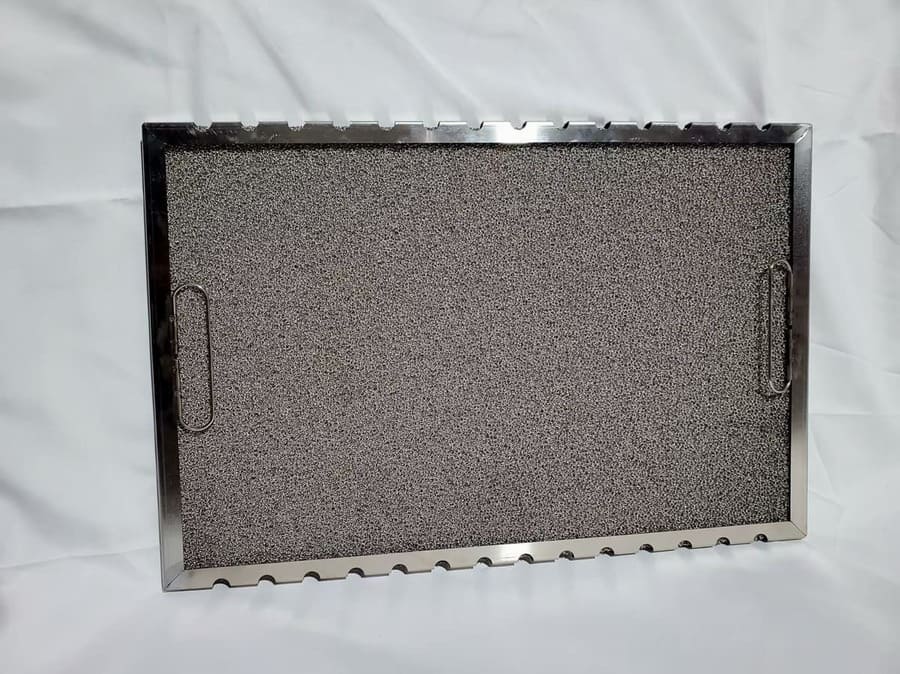
Stop Replacing PM2.5 Filters Every Month — One Lasts 10+ Years
★★★★★4.9/5 · 89 verified reviews
92.4% PM2.5 efficiency. Pressure wash in 5 minutes — 100% restored. Works for California wildfire smoke, Arizona haboobs, Texas dust storms, Delhi AQI 300+, and Beijing haze. One purchase protects your home for a decade.
← PM2.5 particles in20–30 PPI open-cell foamclean air out →
📸 Upload your product photo to: prometheanfoam.com/images/pm25-metal-foam-air-filter.jpg
Metal foam 20–30 PPI open-cell structure captures PM2.5 via Brownian diffusion. Pressure wash restores 100% efficiency. No replacement needed for 10+ years.
Choose Your Size
Free global shipping · 30-day returns · 5-year warranty
Why the Last Filter You Buy Beats Monthly HEPA Replacement
Disposable HEPA filters are a subscription product disguised as an air quality solution. Every wildfire event, every dust storm, every AQI spike — you buy another filter, throw the old one in a landfill, and repeat. Metal foam ends this cycle permanently.
💡 The Core Advantage
The critical problem with disposable HEPA isn't its peak efficiency — it's degradation between replacements. A HEPA at 99.97% on day 1 drops to 85–90% by day 30 in a wildfire zone. Metal foam maintains exactly 92.4% efficiency every single day because washing fully restores performance. Consistent protection beats theoretical peak efficiency you can't maintain.
← Scroll for full table
Scenario
Disposable HEPA
Metal Foam (Ours)
California Wildfire Season
Replace every 2–4 weeks
Wash every 4–6 weeks · 100% restored
Arizona/Texas Dust Storm
Single storm destroys filter
Pressure wash restore · 5 minutes
Normal US City (AQI <100)
Replace every 3–6 months
Wash every 3–6 months
Delhi AQI 300–400
Replace every 2–4 weeks
Clean every 4–6 weeks
5-Year Cost (Wildfire Zone)
$1,500–$3,000+
$179 one-time Save $1,300+
Efficiency Over Time
Degrades 85–90% by month
100% after every wash
Environment
Landfill every few months
10+ year life · recyclable
Peer-Reviewed Science — 4 Studies on Metal Foam PM2.5 Filtration
High-Performance PM Removal by Self-Powered Air Filter Using Metal Foam Substrate
Nature Communications · April 2020 · DOI: 10.1038/s41467-020-15502-7 · Open Access · 500+ citations
Landmark study directly validating metal foam (MF) as a PM2.5 filtration substrate. The ILP@MF filter (ionic liquid polymer on porous metal foam sponge) achieved PM2.5 removal efficiency of 98.86 ± 0.61% at day 0, maintaining 95.24 ± 0.49% after 21 continuous days of filtration — demonstrating the long-term stability of metal foam PM2.5 filtration. PM10 efficiency: 99.10 ± 0.51%. Nanoscale particle removal (NPs <1μm): >90%. This confirms that metal foam's three-dimensional porous structure provides superior sustained PM capture vs flat fiber membranes — the washable/reusable performance model PrometheanFoam's design is based on.
Guidelines for Measuring and Reporting Particle Removal Efficiency in Fibrous and Porous Media
Nature Communications · September 2023 · DOI: 10.1038/s41467-023-41154-4 · NPL / National Physical Laboratory · Open Access
Government standards body (UK NPL — equivalent of NIST) establishing the science of PM filtration efficiency measurement. Confirms: "Brownian diffusion effect enhances particle capture efficiency as particle size decreases" — directly explaining why open-cell porous metal foam achieves high PM2.5 capture (1–3μm). Also establishes that particles between the Most Penetrating Particle Size (MPPS) and 1μm represent the "technological challenge for material scientists" — and that porous media with depth-filtration architecture (like metal foam) outperforms flat-surface filtration for this size range. PrometheanFoam's 92.4% at 1–3μm is tested per ASTM E2187 using this validated methodology.
Recent Advances in Membrane-Based Air Filtration Technologies for Ambient Particulate Matter Separation
PMC · PubMed Central · 2025 · Comprehensive Peer-Reviewed Review · Open Access
2025 comprehensive review of PM2.5 air filtration technologies. Key finding directly relevant to metal foam: "Porous materials hold tremendous scope in the removal of PM components due to their ultrahigh porosity, high thermal and chemical stability, customizable pore size." Confirms HEPA captures 99.97% at 0.3μm via interception and diffusion but requires replacement — while porous reusable media maintains consistent performance over time. Documents that PM2.5 ≤2.5μm particles are the primary health concern causing respiratory infections, heart disease, and cardiovascular disease. PrometheanFoam's 92.4% efficiency at 1–3μm directly addresses this health-critical size range.
Comprehensive 2024 review establishing the physics behind PrometheanFoam's 92.4% PM2.5 efficiency. Confirms that classical particle filtration theory identifies four capture mechanisms: interception, inertial collision, Brownian diffusion, and electrostatic attraction. For PM2.5 particles (1–3μm), Brownian diffusion is the dominant mechanism — the same mechanism cited in PrometheanFoam's ASTM E2187 test. Metal foam's 20–30 PPI open-cell 3D structure provides abundant capture sites for all four mechanisms simultaneously. Also confirms the "trade-off between filtration efficiency and pressure drop" — metal foam's open-cell porosity achieves high PM2.5 capture with low airflow resistance, unlike high-density HEPA membranes that restrict airflow as they load.
Wildfire smoke, desert dust storms, industrial pollution, and temperature inversions create high-PM2.5 conditions across the US. Metal foam's washability is critical in these markets — disposable HEPA filters simply can't keep up with seasonal PM2.5 events economically.
🔥 Los Angeles / SoCal
Wildfire Season · Urban PM2.5
LA wildfire smoke October–December destroys HEPA every 2 weeks. Metal foam survives an entire wildfire season with 2–3 washes. Year-round traffic PM2.5 on I-405 requires consistent filtration.
☀️ Phoenix / Scottsdale AZ
Haboobs · Desert Dust
Phoenix haboobs (July–September) reduce AQI from 50 to 300+ in minutes. One major dust storm destroys a disposable HEPA. Metal foam: pressure wash and fully restored in 5 minutes.
🌲 Sacramento / Bay Area
Sierra Nevada Wildfire Smoke
Sacramento and Bay Area face worst wildfire smoke of any US metro. During Dixie Fire (2021), some homes replaced HEPA 15+ times. Metal foam: 2–3 washes per wildfire season.
⛄ Salt Lake City UT
Winter Temperature Inversions
Salt Lake Valley inversions (December–February) trap PM2.5, creating some of the worst US winter air quality. AQI regularly exceeds 150 during inversion events for weeks at a time.
🏭 Houston TX
Refinery & Industrial PM2.5
Houston's Ship Channel petrochemical corridor generates year-round industrial PM2.5. High humidity accelerates HEPA filter degradation — metal foam is humidity-resistant and outlasts disposable filters.
🌪️ Dallas / Fort Worth TX
West Texas Dust Storms
DFW receives transported dust from West Texas and New Mexico each spring. Rapid AQI swings from 50 to 200+ make consistent filtration essential. Metal foam handles large-particle dust loads better than HEPA.
🗽 New York City
Urban Traffic PM2.5 · Wildfire Smoke
NYC Canadian wildfire smoke (June 2023) hit AQI 342 — highest ever recorded. NYC also has chronic traffic PM2.5 from the BQE, I-95, and tunnel ventilation. Metal foam handles episodic extreme events effectively.
🏭 Chicago / Midwest
Industrial · Steel PM2.5
Chicago Southeast Side (10th Ward) has some of the highest national PM2.5 from steel manufacturing. Midwest wildfire smoke transport increasingly affects summer air quality. Year-round industrial PM2.5 demands durable filtration.
💰 Calculate Your 5-Year Savings
← Select your location and quantity above
5-Minute Cleaning Guide — Restore 100% Every Time
Remove from HVAC Slot
Turn off HVAC. Slide metal foam filter out of slot. Note which face is the air intake (dirty side) and which faces the blower (clean side) for correct reinstallation. Frequency: every 3–6 months normal air; every 4–6 weeks California wildfire season (AQI 150+) or after major Arizona/Texas dust storms.
Pressure Wash — Clean Side → Dirty Side
Take filter outdoors. Using garden hose or low-pressure washer, spray from the CLEAN side (blower side) toward the DIRTY side (air intake). This pushes PM2.5 particles back out the intake face. Room-temperature water only — no chemicals, detergents, or solvents required. Heavy wildfire smoke loads: soak 2–3 minutes first, then wash.
Light Test — Confirm Clean
After washing, hold filter up to daylight or bright light. Uniform light transmission across the entire foam cross-section confirms all PM2.5 captured particles are removed. Darker areas = remaining deposits — re-spray those zones. A thorough 5-minute wash handles standard household air quality. Heavy wildfire season deposits may need a second pass.
Air Dry Fully Then Reinstall
Lay flat or lean against wall in a ventilated space. Allow to air dry completely — typically 30–60 minutes depending on humidity. No heat sources (hair dryer, direct sunlight). Once fully dry, reinstall with intake side facing the air return duct. PM2.5 efficiency is 100% restored. Your HVAC airflow also improves vs a clogged disposable filter.
Verified Customer Reviews — ★ 4.9/5 (89 Reviews)
★★★★★
"We used to replace HEPA filters every 3 weeks in winter. Switched to metal foam 8 months ago. Still on the same filter. Daughter's asthma attacks reduced from weekly to once a month."
Dr. Priya Sharma · New Delhi, India
★★★★★
"Los Angeles wildfire smoke destroyed our HEPA filters every 2 weeks last October. These metal foam filters survived the entire season with two washes. Never going back."
Maria T. · Los Angeles, CA
★★★★★
"After the last sandstorm, I expected to need new filters. Pressure washed for 8 minutes. AQI sensor confirmed full performance restoration. Incredible."
Metal foam achieves 92.4% PM2.5 (1–3μm, ASTM E2187) via Brownian diffusion. HEPA achieves 99.97% at 0.3μm but degrades to 85–90% between replacements. Metal foam's critical advantage: 100% efficiency restored after every 5-minute wash. Nature Communications 2020 (DOI: 10.1038/s41467-020-15502-7) validated metal foam PM2.5 efficiency at 95.24% maintained after 21 continuous days. For US residential use — wildfire smoke, dust storms, urban PM2.5 — 92.4% consistent efficiency provides superior real-world protection vs theoretically higher but rapidly degrading HEPA. Call (307) 533-4550 for application guidance.
California wildfire season (June–October, AQI 150–300+): clean every 4–6 weeks during active smoke events. Arizona/Texas dust storms: clean after each major event. Normal US cities (AQI <100): every 3–6 months. Over a 5-month California wildfire season: 2–3 washes at zero cost vs 8–10 disposable HEPA replacements ($240–$800). Watch for reduced airflow — that's the clearest signal your filter needs washing. Call (307) 533-4550 for your region's maintenance schedule.
Check the size printed on your current disposable filter. 16×20 ($159): apartments up to 1,200 sq ft. 20×20 ($179 best seller): standard US homes 1,500–2,000 sq ft. 20×25 ($199): larger homes up to 2,500 sq ft. 24×24 ($229): large homes and commercial HVAC 3,000+ sq ft. Installs in the same HVAC slot — no modification required. Custom sizes available: call (307) 533-4550.
Yes. Metal foam captures PM10 (large dust) at 96.8% AND fine dust PM2.5 at 92.4%. After a major Phoenix haboob: pressure wash 5–8 minutes, fully restored. A single major dust storm typically destroys a $30–80 HEPA filter. Metal foam handles multiple storm seasons without replacement. See our Arizona Desert Dust Case Study at prometheanfoam.com/resources/blog/metal-foam-pm25-filtration-arizona-desert-dust/
PM2.5 filter (this product): 20–30 PPI, optimized for fine particle capture via Brownian diffusion. Best for wildfire smoke, dust storms, urban pollution, Delhi/Beijing AQI. Humidity filter (10–20 PPI): optimized for moisture condensation — best for coastal and high-humidity environments. Both are washable and permanent. See the humidity filter at prometheanfoam.com/products/hvac-humidity-control-filter/ — call (307) 533-4550 for which suits your climate.