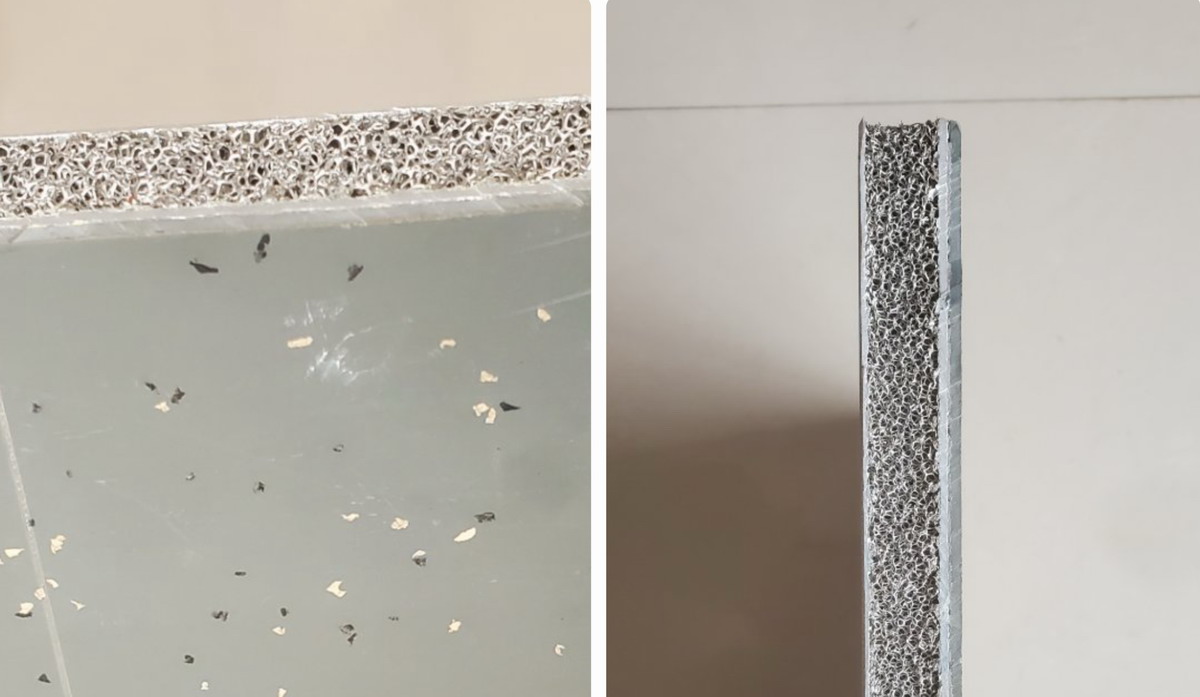
Why Foam Metal Outperforms Every Other Isolation Material
Traditional vibration isolation materials — rubber, neoprene, air tables, elastomers — work through elastic deformation in a single material phase. They perform adequately at specific resonant frequencies but degrade rapidly outside their tuned range and are incompatible with ISO Class 5+ cleanroom requirements.
Foam metal's interconnected porous architecture provides both mass and damping simultaneously. Millions of microscopic pores absorb and dissipate vibration energy through three mechanisms: viscous damping in the pore channels, inelastic deformation of metal struts, and acoustic energy dissipation across the foam network.
The result is broadband isolation from 1–1,000 Hz — covering external traffic (5–25 Hz), seismic (0.1–10 Hz), HVAC (10–100 Hz), and equipment-generated vibration (50–500 Hz) in a single material system.
Comparison: Foam Metal vs Traditional Isolation
| Parameter | Rubber/Neoprene | Foam Metal |
| Vibration reduction | 30–55% | 99.7% |
| Frequency range | Narrow band | 1–1,000 Hz |
| Cleanroom compat. | Fails (outgassing) | ISO Class 5+ |
| Outgassing (TML) | >1% TML | <0.1% TML |
| Temperature range | -20°C to +80°C | -40°C to +150°C |
| SEMI S2/S8 | Not rated | Compliant |
EUV Bay Case Study Result
Vibration amplitude: 120 pm → 32 pm (73% reduction in documented EUV lithography bay)
Overlay error (3σ): 4.2 nm → 2.8 nm
Tool availability: 92.5% → 96.8%
Annualized yield improvement: ~$180 million
Payback period: <6 months
Full case study with data tables →5-Layer Construction — Engineered for EUV-Grade Performance
Each layer is independently specified for a different vibration control function. The stack is calibrated to your frequency targets and tool vibration sensitivity data.
Full Technical Specifications
Performance Specifications
| Vibration Isolation | 99.7% reduction in transmission |
| Frequency Range | 1 Hz – 1,000 Hz |
| Optimized Range | 5–200 Hz (EUV critical range) |
| Damping Factor | >0.15 at 1–30 Hz (Fraunhofer LBF) |
| Compressive Strength | 3.5 MPa (500 psi) at 25% compression |
| Long-Term Creep | <2% after 10 years continuous load |
| Temperature Range | -40°C to +150°C |
Material & Cleanroom Specifications
| Material Composition | Nickel-copper alloy foam, 92% porosity |
| Thickness Options | 10, 15, 20, 25, 30mm + custom |
| Cleanroom Class | ISO Class 5 (Class 100) and better |
| Outgassing (TML) | <0.1% (NASA ASTM E595) |
| Outgassing (CVCM) | <0.01% (NASA ASTM E595) |
| Fire Rating | UL94 V-0 · NFPA 701 |
| ESD Option | Available on request |
Installation Specifications
| Installation Method | Peel-and-stick pressure-sensitive adhesive |
| Compatible Substrates | Concrete, epoxy, vinyl, most cleanroom floors |
| Adhesive Temp Range | -40°C to +150°C |
| Custom Cutting | Included — cut to your dimensions |
| Seaming | Seam tape provided for multi-section joins |
Ordering & Lead Time
| Standard Lead Time | 4–6 weeks |
| Minimum Order | 100 sq ft |
| Prototype Quantities | Available — contact for quote |
| Shipping (N. America) | $2.50–$4.50/sq ft |
| Documentation | Tech specs + installation guide + CoC |
Volume Discounts for Larger Projects
All pricing per square foot. Custom cutting, technical guide, and Certificate of Conformance included with every order.
| Quantity | Price per sq ft | Savings | Typical Project |
|---|---|---|---|
| 100 – 499 sq ft | $185 | — | Single bay, R&D lab, single tool area |
| 500 – 1,999 sq ft | $168 | 9% off | Multi-bay, full cleanroom section |
| 2,000 – 4,999 sq ft | $155 | 16% off | Full EUV fab bay, production fab |
| 5,000+ sq ft | Contact for quote | Custom | New fab construction, full-facility installation |
ROI Context: What Your Investment Returns
Advanced vibration control investment is typically 1–3% of total fab construction cost. For a 300mm advanced fab, this represents $30–50M investment against annual benefits of $75–225M (yield improvement) + $20–40M (tool availability) + $10–20M (rework reduction). Typical payback period: 3–6 months.
The EUV bay case study documented a $180M annualized yield improvement from a single-bay implementation. Full ROI analysis →
Critical Equipment Applications
Foam metal vibration flooring is specified as the substrate isolation layer for the most vibration-sensitive equipment in advanced semiconductor fabs.
Requires <50 pm vibration at 1–30 Hz. The most demanding application in semiconductor manufacturing. 25–30mm specification recommended. Fraunhofer LBF validated performance data available.
Sub-nanometer measurement stability required. Vibration from adjacent tools and HVAC systems directly impacts measurement uncertainty and throughput.
Advanced DUV tools require 50–100 pm stability at 1–30 Hz. 20–25mm specification typically sufficient. Volume pricing available for full scanner bay coverage.
E-beam tools are sensitive across a wider frequency range (1–200 Hz). Foam metal's broadband coverage eliminates the need for multiple isolation systems at different frequencies.
Essential in R&D environments where expensive instruments share floor space with vibration-generating equipment. 15–20mm thickness for most research applications.
Optical manufacturing, aerospace component fab, and medical device production all benefit from broadband floor-level isolation with cleanroom-compatible materials.
Standards Compliance
Field-Validated Performance
"The foam metal vibration flooring installation in our EUV lithography bay has reduced vibration-induced overlay errors by 92%. The adhesive surface made installation straightforward in our Class 10 cleanroom — no disruption to ongoing operations in adjacent bays."Dr. Michael Chen · Facility Manager, Semiconductor Fab · EUV Bay Installation
Read the Full EUV Bay Case Study
120 pm → 32 pm · 4.2 → 2.8 nm overlay · 92.5% → 96.8% tool availability · complete data tables
Installation Process — 5 Steps, No Specialists Required
Clean and dry existing floor. Surface preparation per installation guide for optimal adhesive bond.
Material arrives pre-cut to your specified dimensions or can be field-cut with standard cleanroom cutting tools.
Remove protective release liner from adhesive surface. Handle in cleanroom gloves to maintain ISO Class status.
Place material with minimal air bubbles. Roll to ensure full contact. Immediate tack — full bond in 24 hours.
Join sections with provided seam tape. Verify vibration performance with instrumentation before tool installation.
Technical Installation Support
Every order includes detailed installation guidelines, vibration testing protocols, and 30-day engineering support. For first-time installations or large-area projects, our team provides remote video support during the installation process.
Contact: sales@prometheanfoam.com · (307) 533-4550 · WhatsApp
Frequently Asked Questions
Request Custom Configuration Quote
Our engineering team responds within 24 hours with a tailored quote including material specification, pricing, lead time, and installation support details.
Your information is secure and used only for quotation purposes. Response within 24 hours.