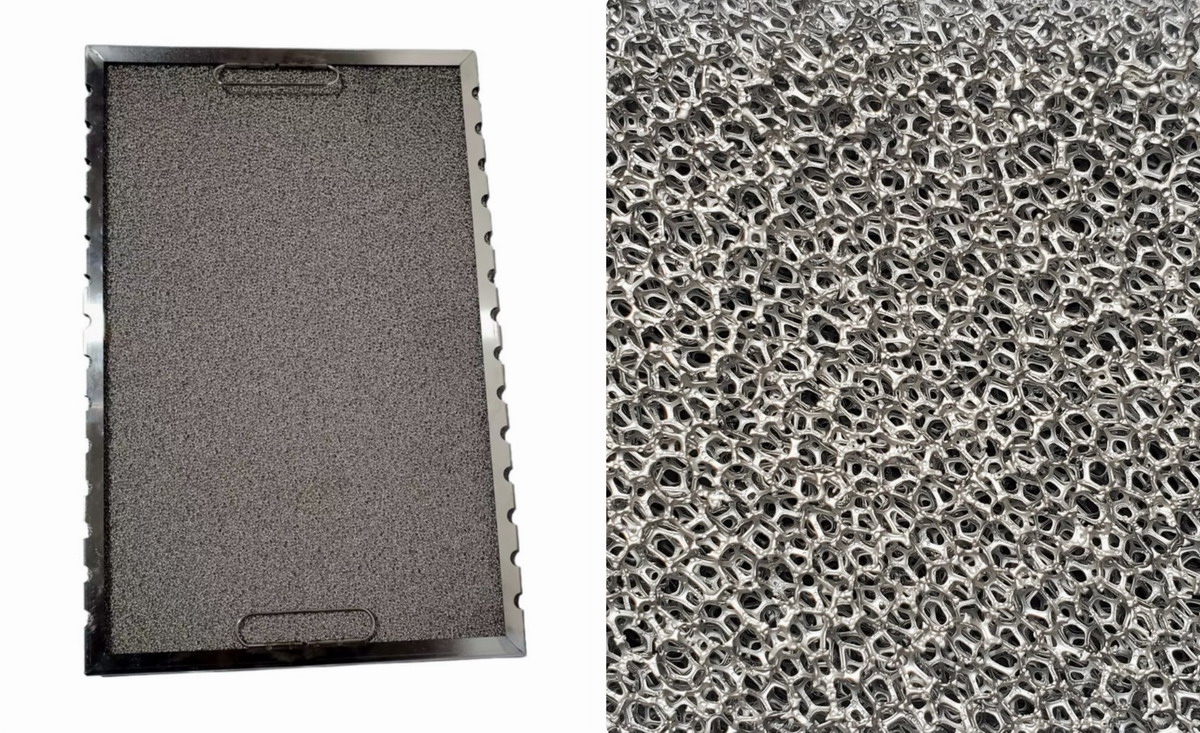
The Filter You Replace Every 3 Months Is Failing You
The physical limits of fiber filter media are fundamental: they can only capture particles efficiently above 10μm before performance declines. The more they filter, the more they clog. The more they clog, the more pressure drop builds. The more pressure drop builds, the harder your HVAC fan works — and the sooner efficiency falls to zero.
And then you throw it away. Billions of disposable filter cartridges end up in landfills globally each year. Metal foam ends this cycle permanently.
- 3–6 month lifespan
- Discard and replace — $30–80 each time
- Performance degrades as it loads
- Particles only — moisture destroys it
- Max 250°F — fails in grease fires
- $600–$3,200 per filter over 10 years
- 10+ year lifespan
- Wash in 5 minutes — 100% efficiency restored
- Consistent performance across full lifespan
- Particles + moisture condensation + grease liquefaction
- 1,650°F rated — NFPA 96 compliant
- $150–300 once — $0 replacements for 10+ years
Metal Foam vs HEPA: Every Performance Metric
| Parameter | HEPA Filter | Metal Foam Filter | Advantage |
|---|---|---|---|
| PM2.5 Capture (1–3μm) | 85–95% | 92.4% | Comparable at baseline, no degradation over time |
| Moisture Handling | Degrades when wet | Condenses to liquid | Metal foam thrives in humidity; HEPA fails |
| Grease Capture | Not designed for grease | 95%+ liquefaction | Metal foam is the only option for kitchen hoods |
| Lifespan | 3–6 months | 10+ years | 20–40× longer |
| Replacement Cost | $30–80 every 3–6 months | $0 after purchase | 76–96% lifetime savings |
| Temperature Resistance | Max 250°F | 1,650°F continuous | 6.6× higher — required for kitchen fire safety |
| Pressure Drop | Rises as filter loads | Stable — washable | Consistent HVAC efficiency |
Why a Metal Sponge Outperforms Every Filter on the Market
Three Capture Mechanisms Working Simultaneously
HEPA filters work through one primary mechanism: mechanical entrapment in fiber media. When the media fills, efficiency drops. Metal foam works through three simultaneous physical mechanisms — each targeting a different particle size range.
Particles traveling straight can't follow air as it curves around foam skeleton — they impact the metal surface and are captured. Cleans via pressure wash.
Particles follow airflow but pass too close to the metal skeleton — contact adhesion captures them. The 12× surface area advantage over baffle filters maximizes this mechanism.
Ultrafine particles randomly wander due to molecular collisions — statistically collide with foam skeleton in the 3D network and are captured. This is PM2.5 territory.
The Physics of Moisture and Grease Liquefaction
This is the capability that no other filter type can replicate. The three-dimensional porous structure of metal foam provides 12× more surface area than equivalent baffle filters of the same footprint. When humid air or grease-laden exhaust passes through, the temperature differential on the metal surface triggers condensation — gas turns to liquid, liquid flows down the metal skeleton, collects in drainage channels at the bottom of the frame.
Condensation Physics — Why Metal Foam Does What HEPA Cannot
Traditional fiber filter: Captures gas-phase particles by entrapment. Moisture saturates the media. Mold grows. Structure collapses. Replace.
Metal foam: Metal surface with controlled pore density (10–30 PPI) provides optimal surface-to-volume ratio for condensation. Gas → liquid → drains. No saturation. No mold. No structural degradation. Wash and continue.
The same mechanism that turns moisture into liquid water also liquefies grease vapor — preventing grease from ever reaching the ductwork downstream.
See the HVAC Humidity Control Filter
92.4% PM2.5 · 0W passive humidity control · 10+ yr lifespan · From $219 · 304 SS frame · Ships 3–5 days
Tested at the Extremes
Central Pollution Control Board winter data shows consistent 300–500 AQI conditions from November to February. Traditional filters clog in 2–4 weeks under these loads.
- Clogs in 2–4 weeks
- Pressure drop spikes
- Efficiency plummets
- $300–600/yr in replacements
- Inspect every 4–6 weeks
- 5-min pressure wash
- 100% efficiency restored
- $0/yr after purchase
Florida's subtropical humidity causes mold growth, structural softening, and efficiency loss in fiber filter media — often within weeks in coastal environments.
- Mold growth in damp media
- Structural collapse
- Efficiency → zero when wet
- Replacement cycle accelerates
- Condenses moisture to liquid
- Drains — doesn't saturate
- 304 SS: no rust, no mold
- Performance unchanged
For residential and commercial buildings in these environments, PrometheanFoam's PM2.5 air filter is available in custom dimensions with hreflang-localized support for Delhi (Hindi), Beijing (Simplified Chinese), and Middle East (Arabic) markets. For HVAC humidity control specifically, the HVAC humidity control filter includes integrated condensation drainage channels optimized for Florida, Gulf Coast, and tropical climate conditions.
Commercial Kitchen: Grease Vapor Into Liquid Before It Reaches Your Ducts
The root cause of most commercial kitchen duct fires: grease vapor particles pass through baffle filters and deposit in ductwork. Traditional baffle filters capture only 70–80% — the remaining 20–30% enters ducts and builds up over time. Metal foam capture rate: 95%+.
The Grease Liquefaction Process — Why Metal Foam Stops Duct Fires
Metal foam doesn't just trap grease particles — its 3D surface area triggers condensation of grease vapor into liquid, which flows down the frame into collection channels at the base. The grease never reaches the duct.
This is physically impossible for baffle filters, which rely only on inertial impaction. 20–30% of grease load passes through baffles as fine aerosol and vapor.
Case study: A 12-seat BBQ restaurant — one of the highest grease-load kitchen types — recorded zero fire incidents in 2 years after switching to metal foam kitchen hood filters, and $2,100/year in reduced insurance premiums. Full ASTM E2187 and UL 1046 flame test data is available in the complete engineering comparison →
The Last Filter You'll Ever Buy: 10-Year Cost Analysis
| Cost Category | HEPA / Traditional (Residential) | Metal Foam | Savings |
|---|---|---|---|
| Initial Cost | $30–80 | $150–300 | — |
| Replacement Frequency | Every 3–6 months | Never — permanent | Permanent |
| 10-Year Replacement Cost | $600–3,200 | $0 | $600–3,200 saved |
| Cleaning Time (per event) | 30 min (install new) | 5 min (wash) | 25 min saved each time |
| 10-Year Total Cost | $600–3,200 | $150–300 | $450–2,900 savings |
Why Major Retailers Won't Stock Metal Foam Filters
Search Walmart. Search Amazon. You won't find metal foam HVAC filters. The reason is structural: major retailers operate on consumables subscription economics — they require repeat purchases. A product that lasts 10+ years with $0 replacement cost breaks this model entirely.
PrometheanFoam is one of the only US manufacturers producing metal foam filters at scale and selling factory-direct to end users — no distributor markup, no retail shelf. When you need to test before committing, sample kits ($79) are available for hands-on evaluation in your specific HVAC system.
For larger-scale commercial installations or non-standard dimensions, see custom manufacturing with 7-day prototype turnaround →
Common Questions
Ready to Replace Your Last Filter?
500+ installations. 50 countries. Order a sample kit to test in your HVAC system before committing.